

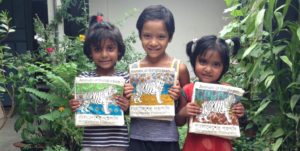
Reflections on craft product development from the eyes of an industrial (product) designer.
While living in Bangladesh, one of the social businesses that I worked with was Sacred Mark Enterprise (SME), which works to provide alternative employment to former sex workers through handicraft production. My support centered around graduating this business from being incubated under an NGO to an independent entity. During the process, the manager learned that I had a background in design, and so she requested that I design a product for her. I agreed, but it took more than a year before something came to mind.
1.Inspiration
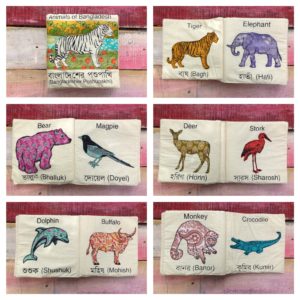
While working with SME, I learned a lot about their business and market. Through 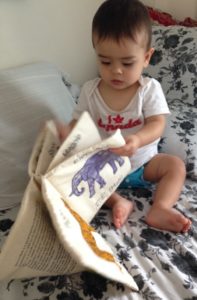 my observations, I was able to see what products were popular, and I also began to notice some market gaps. These subtle observations didn’t amount to anything at first, until my personal context changed and my wife and I had our first child. This enabled me to see life from a different perspective as I was forced to develop empathy for a new demographic. As a first-time parent, I was excited for the opportunity to nurture a new and curious mind. Living in a cross-cultural context, I also wanted to be able to showcase the richness of different cultures and languages. I was eager to read a wide range of books to my child, and was struck at the beauty of communicating knowledge through simple words and pictures. This had a lot in common with books for people learning new languages.
2.Ideation
With all these new elements swirling around in my head, I started to mentally explore different ideas of potential new products for SME, and I soon landed with developing a cloth book using recycled saris. For the design to be feasible, I knew I had to develop something within a few constraints. SME worked with recycled saris to make blankets and other decorative items, so this was a material they were familiar with, and they also had experienced seamstresses. Additionally, they had some basic experience with screen printing, so I knew it was within their capacity.
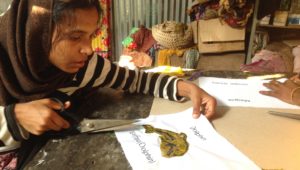
For the design to be successful, I knew that it needed to differentiate itself from what was currently available. Based on my earlier observations, I knew that recycled sari products were very popular for the export market and the more successful products had a functional element to it. I also noticed a new opportunity for showcasing the ancient and poetic language of Bengali; there were no products in the handicraft market in this category. As I refined my ideas into a design, I mocked-up a few pages using photoshop that I then shared with some potential customers and the production team at SME for their initial thoughts.
3.Implementation
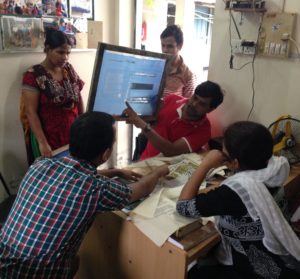
The initial feedback on the concept was very positive, so we then began to develop a prototype to test out the materials, labour, costs, durability, quality, and customer feedback. This process was extremely insightful and as a result we changed some of our material choices to improve the quality and aesthetics, refined the design to reduce production time, settle on a price point, and were able to get quick customer insight. Prototyping helped us validate the concept and refine the product so that it could meet customer demand while being feasible to produce.
4.Introspection
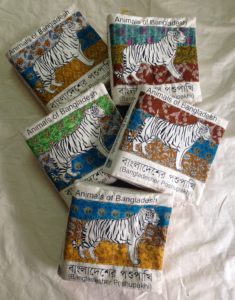 By the time I finished my work in Bangladesh, this product was officially ready to hit the market and it had shown initial interest from customers locally and abroad. At this junction where products enter into a market, it is important to note that the product development process is always iterative, with ongoing feedback being worked into future improvements. Nevertheless, in many ways the marketing component is where the real challenge to the success of a product lies as one tries to showcase their product.
The process for this product’s development was not what I originally expected, but then again, all products go through their own creative development journey, with each step building off each other. Creativity doesn’t happen in a vacuum. Creativity requires various building blocks to come together to create something. This is the ongoing process that SME still carries forward.
To see the full product album, click here.
If you are interested in buying one of these cloth books, please email: contact@prokritee.com
 Nishant Das is an industrial (product) designer by training, with an MBA in economic development. Having started his career in Canada in product design and engineering at an established furniture company, he now focuses his expertise within the development context. Nishant has worked in Bangladesh where he advised social business and worked to improve local market systems, and is currently in Papua New Guinea where he works for an NGO managing economic development projects in the Pacific.